Posts

My C2 Proficiency book review: Grammar Nonsense and What To Do about It

Image
Most writing prompts in the C2 Proficiency writing test consist of three points. One problem I often see in students' answers is that the answer is three isolated pieces, rather than one complete whole. In this book review I wrote for my C2 Proficiency Writing students, I was aiming to show how the answer can be connected on the level of the whole text and be one complete whole. The prompt was written by me too.  An ELT magazine has invited readers to submit reviews of books for teachers. You decide to submit a review of a book that you read recently. Your review should briefly describe the book, explain what impact it had on your professional life, and assess the importance of reading professional literature. ✽✽✽ I am not big on reading books about teaching, guilty as charged, but when this book came out, I bought it on the first day and binge-read it in two hours. “Grammar Nonsense and What To Do about It” by Hugh Dellar and Andrew Walkley is not a book. It’s a rant, a rant about...
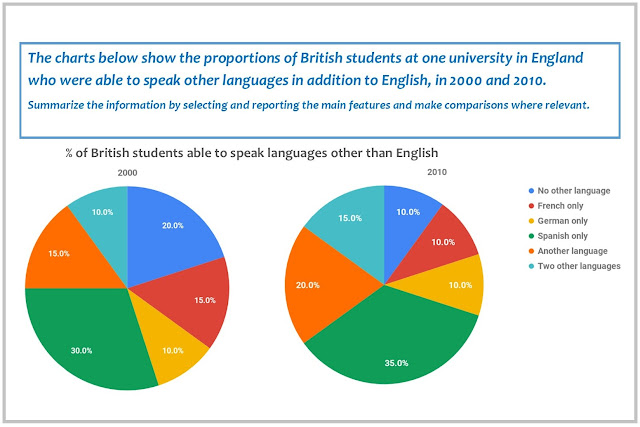
How to tame your IELTS pie charts

Image
IELTS line graphs are easy to tame - you just go chronologically, so the description doesn't get out of hand. Information in pie charts, however, can be hard to organize because there are different directions you can go in. In this post, I want to share two IELTS pie chart answers I wrote for the same task. The task is from Cambridge IELTS 11 . The introduction and the overview are the same. As you read, pay attention to the organization and try to decide which description works better. ✼✼✼ Introduction  The pie charts compare the percentage of British students of one English university who knew foreign languages in 2000 and 2010. Main Body Version 1 The percentage of students in three groups grew. Speakers of Spanish formed the largest share in both years, rising by 5% from 30% to 35%. The increase was the same in the “Another language” and “Two other languages” groups. In 2010, the former amounted to 20%, while the latter comprised 15%, making up the second and third largest prop...

A surefire path to happiness

Image
✼✼✼ “What is your name?” “Irina.” “And what is your address?” Little did I know these questions were about to usher in the happiest moment of my life. After the crash, all went black. In one big blur, I was carried from the car to the ground, to the ambulance, to the hospital. It was beginning to slowly dawn on me what had happened. The word terrifying doesn’t do it justice. But was I breathing? I was. Did I remember my name? I did. Could I recall my address? I could. Were those doctors around me? They were. The feeling of overwhelming, all-consuming happiness was ballooning inside me with each question. I was alive, in my right mind, being taken care of. If you’ve been in a car crash, you’ll know the feeling. Most people haven’t. They think they have all the time in the world, so they delay happiness. Happiness is to be experienced some time in the future. Happiness is to be experienced when they graduate, get married, buy an apartment, reach that goal, fulfil that dream. Not that the...

Poetry: best English workout few know about

Image
This is a guest post by Timur Khamzin , a programmer who writes and translates poetry in his free time. In this post, he talks about the whys and hows of his hobby. What Timur does is inspiring and mind-blowing. You can find his bilingual poetry and translations in his community on VK  Переводы стихов | Poetry Translations . Choosing poetic form Don’t be hasty to reel back in horror when I tell you it is writing poetry that I refer to in the headline, not reading it (although that can also be a treat). Some of your apprehensions may turn out to be misconceptions, e.g. “only people with special aptitude can write poetry” or “I lack inspiration that is an indispensable ingredient of writing a good poem”. Writing poetry is a skill to be learnt , like driving a car or doing yoga. What makes it particularly enticing for language learners is that it has the fortunate and lasting side-effects of enriching vocabulary, enhancing precision and sense of style. Now, there is writing poetry and...

How to fancify your language in no easy steps

Image
This is a guest post by  Anna Pakhomova , my C2 Proficiency student whose skillful use of fancy language will completely blow you away. In this post, she shares her story and her tips.    I realize how disgustingly self-assured this sounds, so I’ll just go ahead and burst my own bubble here. In this guest post, graciously suggested by Irina, I’ll try to show the darker, duller and more mundane part of putting together your own personal toolbox (or, more precisely, a warehouse) of fancy lexis. First off, the way I learned most of my so-called “fancy” vocabulary was by being a decidedly lonely kid at school. I was a full package – I wore thick glasses, had braces permanently in, and was too smart for my own good. At that point, reading virtual tons of books and learning English was my super power, my magical shield against the world I didn’t particularly enjoy. It wasn’t that I was bullied – oh, I was unapproachable in my little ivory tower. It’s just that I, as any self-re...

Can you write about your language learning routine?

Image
“Can you write about your language learning routine?” This is a question I got from my student Nina. My answer is, “Sure, but I don't really have a routine. It's more of a way of life.” In this post, I want to share my language learning lifestyle. Input First and foremost, I pretty much live my life in English . 99% of my environment (my devices, software, apps, subscriptions, books, videos et cetera et cetera) is in English. I make sure I expose myself to copious amounts of English. Exposure is king. So is noticing. I am always on the lookout for new vocabulary and familiar vocabulary used in new ways. Most of the time I read or watch something I take vocabulary notes. I have a paper notebook and digital notes for that. If I don’t have them on me when I hear a great expression, I jot it down on an old receipt or whatever I can find. My main criterion for choosing what language to take notes of is a very honest answer to these questions, "Would I ever say it t...

How to write a great exchange program application

Image
The 🔹🔹🔹 competition is now open. As the program alumna, I’ve decided to put together some tips that can help you write a great application. I think the tips will work for many other programs and scholarships. Participating in the program was a truly eye-opening and life-changing experience for me, which you can find out more about by reading my other posts (see the links at the bottom of this one). Check the requirements on the official website and go for it if you are eligible. My top tips on writing great application essays #1 Don't Google how to write applications and don’t look at other people’s essays. Everything you find online will also be found by other potential participants who google and find the same thing. Just don't. Tap into your own inner resources. Make your application unique and memorable. The decision makers read hundreds of applications. It will play in your favor to stand out. #2 Start brainstorming and writing your first draft very earl...